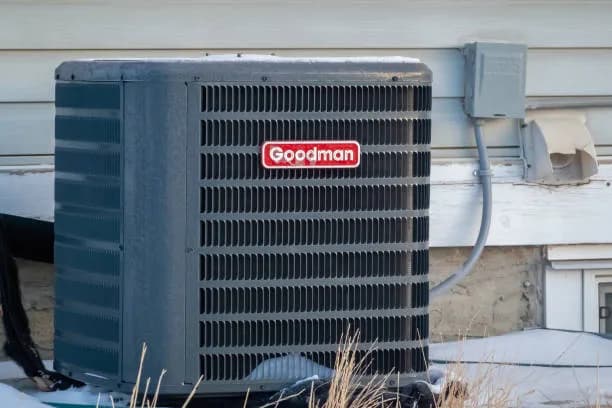
AC sizing in the GTA matters even more than furnace sizing because oversized AC units actively make your home less comfortable. They cool fast but don't run long enough to dehumidify — leaving you with a cold, clammy basement and humid main floor. Right-sized cooling means even temperatures and proper moisture control on hot Toronto August days.
Quick Estimate (Starting Point Only)
- Well-insulated post-2010 home with good windows: 1 ton per 700–900 sq ft
- Typical 1980–2010 home: 1 ton per 600–700 sq ft
- Older home (pre-1980): 1 ton per 500–600 sq ft
- Top floor / west-facing rooms / vaulted ceilings: bias toward smaller per-ton coverage
1 ton = 12,000 BTU/hr cooling. Common residential sizes: 1.5, 2, 2.5, 3, 3.5, 4, 5 tons. Rough range: 2,000 sq ft typical GTA home → 2.5–3 tons.
Why Oversizing Is Worse Than Undersizing for AC
Oversized AC reaches the thermostat setpoint in 5–8 minutes — too fast to remove humidity. Result: indoor temperature is 23°C but humidity is 65%, making the home feel sticky. Undersized AC runs longer (good for dehumidification) but may not keep up on the hottest 5 days of summer. The 'compromise' is usually to size correctly and use a two-stage or variable-capacity unit, not to deliberately oversize.
Two-Stage and Inverter ACs — Forgiveness for Sizing
Modern two-stage ACs run at low capacity (~65%) most of the time and high only on hot afternoons. Variable-capacity inverter units modulate continuously 30–100%. Both run longer at lower output, which dehumidifies properly even if slightly oversized. If you're between sizes, two-stage / inverter resolves the conflict.
Manual J — Same Tool as Furnace Sizing
AC sizing uses a cooling-load Manual J calculation. It factors in window orientation (west and south windows add huge cooling load), shade, occupancy, lighting heat, and infiltration. The cooling-design temperature for the GTA is 30–32°C with 60% humidity. A proper Manual J takes 30–60 minutes onsite — see [furnace sizing guide](/blog/what-size-furnace-do-i-need-toronto) for more detail on the methodology.
When to Match AC and Furnace
If you're replacing both at the same time, the AC and furnace blower must be matched for proper airflow (400 CFM per ton of cooling). A 3-ton AC needs a 1,200 CFM blower minimum — most modern ECM-blower furnaces can handle 2.5–4 tons. If you're keeping an existing furnace and adding new AC, verify the blower CFM matches the new AC's tonnage.
Special Cases
- Multi-storey homes with no second-floor return ducts: undersize slightly to avoid excessive humidity in basement
- Homes with multiple west or south-facing window walls: bias toward larger size or zone
- Open-concept main floor + bedrooms: consider a ductless mini-split for upstairs in addition to central AC
- Older homes with no AC currently: ductwork inspection mandatory before sizing — 60-year-old ducts may need rework
Get a Proper AC Quote
ZK Mechanical sizes every AC install with a Manual J cooling load calculation, matches AC tonnage to furnace blower CFM, and inspects ductwork before quoting. We install [air conditioners](/services/air-conditioner) and [ductless mini-splits](/services/cooling) across the GTA. [Request a free quote](/contact).
Frequently Asked Questions
How many tons of AC do I need for a 2,000 sq ft house?
Is it better to undersize or oversize an AC?
Can my existing furnace blower handle a new AC?
Why does my old AC keep up but a 'right-sized' one feels weaker?
Should I get a single-stage, two-stage, or inverter AC?
Related ZK Mechanical Services
Need help with this in your home or business? Our licensed technicians serve the Greater Toronto and Hamilton Area.