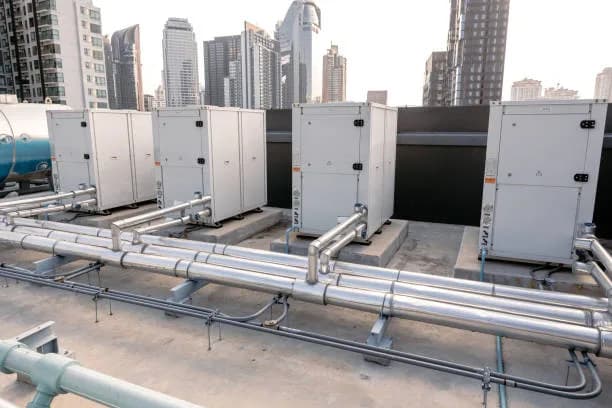
Commercial rooftop units (RTUs) are the workhorses of GTA commercial buildings — strip malls along Steeles, office buildings on Bloor, retail boxes in Vaughan, light industrial in Mississauga. They typically last 15–20 years, which means a wave of RTUs installed during the 2005–2010 commercial construction boom are aging out right now. If you're a property manager planning replacements in 2026, this guide covers real costs, crane logistics, rebate programs, and the scheduling moves that minimize tenant disruption.
RTU Replacement Cost in the GTA (2026)
- Single-zone packaged RTU, 5-ton: $14,000 – $22,000 installed
- Single-zone packaged RTU, 10-ton: $22,000 – $35,000 installed
- High-efficiency condensing gas RTU, 7.5-ton: $25,000 – $38,000 installed (qualifies for Enbridge commercial incentives)
- Variable-capacity RTU with economizer, 10-ton: $32,000 – $48,000 installed
- Make-up air unit (MAU), 5,000 CFM: $30,000 – $55,000 installed
- Crane mobilization (added to all of above): $1,500 – $5,000 per crane day depending on building height and access
Why Multi-Unit Replacements Save Money
Crane time is the single biggest 'fixed cost' in RTU replacement. Mobilizing a 60-ton crane to a Mississauga industrial building runs $2,500–$4,500 minimum, regardless of whether you replace one unit or four. If your building has multiple aging RTUs, planning a same-day or same-week replacement amortizes that crane cost across all units. We routinely see per-unit savings of $1,500–$3,000 when property managers bundle 3+ RTU replacements. Don't let the lowest-bid contractor talk you into single-unit replacements over multiple visits — they're optimizing for their schedule, not your budget.
Scheduling Logistics That Minimize Tenant Disruption
- Spring (April-May) and fall (October-November) are ideal — moderate weather means tenants can tolerate brief HVAC outages
- Summer (July-August) is the worst time — peak cooling demand makes any outage catastrophic for tenants
- Winter (Dec-Feb) is acceptable for cooling-dominated RTUs (offices) but risky for heating-dominated ones
- Early-morning crane work (5–8 AM) is often city-permitted with advance notice and has the bonus of catching tenants before they arrive
- Plan a 4-hour minimum outage window per unit; schedule as overnight or weekend work for retail / restaurant tenants
- Notify tenants 2 weeks in advance with specific date, time window, and contingency for delay
Permits and Compliance in 2026
- City building permit required (typical $400–$1,200 depending on municipality and unit size)
- TSSA gas permit and inspection for any unit with a gas heating section
- Environmental Compliance Approval (ECA) review for units >100 kW heat input
- If replacing R-410A with new A2L equipment (R-454B), refrigerant disposal and tracking required under federal regulations
- Roof structural assessment if upgrading to a heavier unit (recommended for any buildings 25+ years old)
2026 Commercial Rebates and Incentives
Enbridge's Commercial and Industrial Prescriptive Incentive Program offers per-unit rebates for qualifying high-efficiency equipment — condensing rooftop units, condensing make-up air, high-efficiency boilers. For 2026, equipment must be purchased between January 1 and September 30, 2026, and installed by October 31, 2026. Typical rebate amounts run $500–$2,500 per qualifying RTU depending on size and efficiency tier. Save on Energy also offers commercial smart-thermostat and BAS (building automation system) incentives that stack on top.
Should You Repair or Replace?
- Under 10 years old: repair almost always wins, even for major component failures
- 10–15 years: depends on the failure — heat exchanger crack means replace; compressor in mid-life unit might be worth repair
- Over 15 years: replace. Repair costs on aging RTUs spiral, and you're missing 30%+ efficiency gains from current equipment
- Multiple failures in 24 months: replace, regardless of age
- Refrigerant phase-out: any R-22 unit (some still operating in older buildings) must be replaced — R-22 is no longer available
Energy Efficiency Gains from Modern RTUs
A 2008-vintage 10-ton RTU at 9 EER is being replaced today by 11.5–13 EER units — a 27–44% efficiency gain in cooling alone. Add a high-efficiency condensing gas section (95% AFUE vs. 81% legacy) and total energy spend on a single unit drops 20–30%. For a Toronto retail building running four 10-ton RTUs, that translates to $4,000–$8,000/year in lower utility bills — meaning the upgrade pays itself back in 6–9 years before any rebate is applied.
Common Mistakes Property Managers Make
- Selecting on lowest bid alone — RTU specs vary widely, and the cheapest install often skips proper duct sealing, economizer commissioning, and BAS integration
- Not requiring a like-for-like sizing analysis — RTUs are often oversized at original install; new equipment can usually be downsized 10–20%
- Skipping the economizer — modern RTUs with proper economizers cut cooling cost dramatically in shoulder seasons
- Forgetting curb adapter costs — replacing a 2008 unit with a 2026 unit usually requires a curb adapter ($500–$1,500) due to different footprint
- Not bundling multiple-unit replacements to amortize crane cost
Why Choose ZK Mechanical for Commercial RTU Work
We service commercial properties across the GTA — retail plazas, office buildings, light industrial, restaurants, and multi-tenant complexes. Our team handles full project management: structural assessment, permits, crane scheduling, tenant communication, equipment selection, install, commissioning, and rebate paperwork. We carry a $5M liability policy and have an established TSSA compliance record. See our [commercial HVAC services](/services/commercial-hvac) for the full scope of work, or [contact us](/contact) to scope an RTU replacement project.
Related ZK Mechanical Services
Need help with this in your home or business? Our licensed technicians serve the Greater Toronto and Hamilton Area.