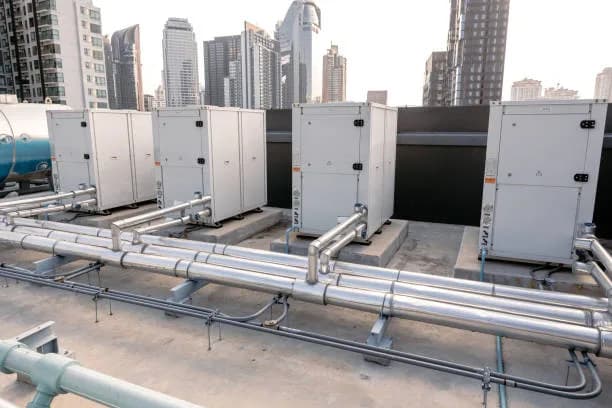
RTUs (rooftop units) and split systems are the two dominant commercial HVAC configurations in the GTA. They serve different building types and have very different cost, maintenance, and lifespan profiles. The right choice depends on your building's roof structure, available space, zoning needs, and long-term plans.
Rooftop Unit (RTU) — At a Glance
- All components (compressor, evaporator, gas heat, blower) packaged in a single cabinet on the roof
- Single duct connection through the roof penetration
- Typical capacity: 5 to 25+ tons cooling, 100k to 400k BTU heating
- Common in: strip malls, retail boxes, warehouses, single-tenant offices, light industrial
- Lifespan: 15–20 years
- Replacement cost: $14,000 – $48,000+ per unit installed (see [commercial RTU replacement guide](/blog/commercial-rtu-replacement-toronto-property-managers))
Split System — At a Glance
- Compressor and condenser outside (ground or roof), evaporator and air handler inside (typically mechanical room)
- Refrigerant lines connect the two — installed by professionals only
- Typical capacity: 1.5 to 30 tons cooling depending on configuration
- Common in: multi-tenant offices, restaurants needing zone control, hotels, residential-converted-to-commercial buildings
- Lifespan: 15–20 years
- Replacement cost: $9,000 – $40,000 depending on size
When RTUs Win
- Building has flat roof with structural capacity for HVAC equipment
- Single zone or simple multi-zone setup acceptable
- Want all equipment outside the leased space (frees up tenant area)
- Preference for simpler service access (everything on the roof)
- Short-term lease with multiple tenants — RTUs make zone changes simpler
When Split Systems Win
- Roof can't support an RTU (sloped, lightweight construction, heritage building)
- Multi-zone requirements with VRF (variable refrigerant flow) capability
- Lower noise requirements (compressors can be ground-mounted away from tenants)
- Custom airflow needs (industrial process cooling, server rooms)
- Heritage facade preservation — outdoor units can be ground-mounted out of sight
VRF / VRV — The Modern Split System Evolution
Variable Refrigerant Flow (VRF) systems are advanced split systems with one outdoor unit serving 8–32 indoor units, each with independent zone control and inverter-driven capacity modulation. Increasingly common in newer GTA office buildings and hotels. Higher upfront cost, dramatically better part-load efficiency, and individual tenant zoning. Brands: Daikin VRV, Mitsubishi City Multi, LG Multi V.
Cost Comparison
- Single 10-ton RTU: $22,000 – $35,000 installed
- Equivalent split system (10-ton condenser + air handler): $18,000 – $32,000 installed
- 10-ton VRF with 8 indoor heads: $35,000 – $60,000 installed (higher capability)
- Crane mobilization for RTUs: $1,500 – $5,000 per crane day
Maintenance Differences
- RTU: roof access required for all service. Single point-of-failure (whole unit replaced when major component fails). Bird/debris exposure on filters and coils.
- Split: ground or basement access for outdoor compressor. Indoor air handler accessible without ladder. Components can be replaced individually.
Which Should You Choose?
For most simple GTA commercial buildings (strip malls, single-tenant offices, warehouses, retail), RTUs are the standard and cost-effective choice. For multi-tenant buildings, restaurants with multiple zones, or buildings where the roof can't support an RTU, split systems make more sense. For new construction or major renovations of multi-tenant buildings, VRF is increasingly the right answer. ZK Mechanical designs and installs all three across the GTA — see our [commercial HVAC services](/services/commercial-hvac) for full scope, or [contact us](/contact) for project-specific recommendations.
Frequently Asked Questions
What is a rooftop unit (RTU)?
What is a split HVAC system?
Which is more expensive — RTU or split?
How long does a commercial RTU last?
Can I convert from RTU to split system or vice versa?
Related ZK Mechanical Services
Need help with this in your home or business? Our licensed technicians serve the Greater Toronto and Hamilton Area.